
Caught in AI Gears
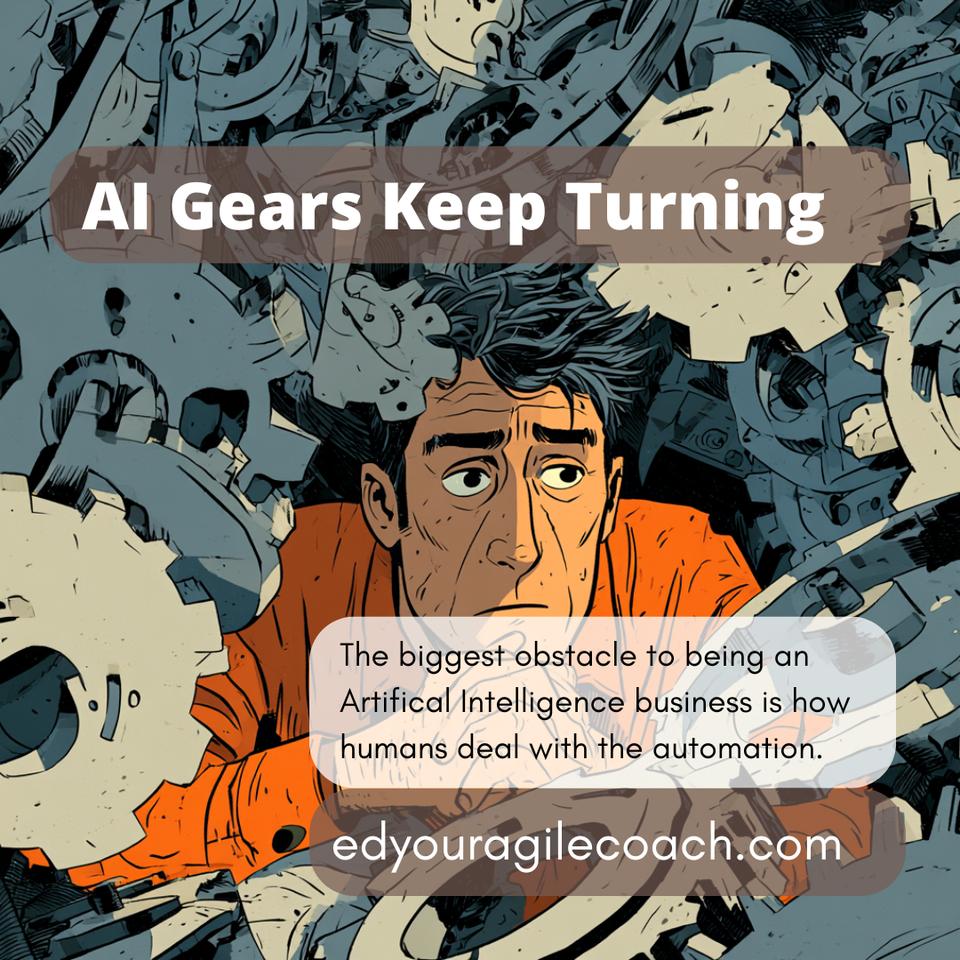
One of the most iconic scenes in film history came from Charlie Chaplin. In Modern Times, he parodies modern factories and the growing industrialization taking over the global economy. In one scene, he falls behind on an assembly line, struggling to keep up. Eventually, he is pulled into the machinery and twisted between the gears for comedic effect. It is required viewing for many film students and critics. Social commentators often point out that the movie was Chaplin's way of expressing his frustration with a cruel manufacturing economy.
Gears in the Digital Machine -
With the increasing headlines and concerns surrounding Artificial Intelligence, I keep thinking about that tramp caught in the gears of the machinery he does not understand. Business leaders are demanding more automation and adoption of this technology. The reality is that many organizations are simply not designed for that level of speed or agility. Furthermore, many business leaders are struggling to be accountable for decisions made with the help of artificial intelligence.
Elon Musk’s recent interview with The Economist went poorly, largely because the interviewer refused to fawn over him. In that interview, Elon proclaimed that we would live in a post-scarcity economy where money would be worthless. Like plenty of things Elon says, this statement should be treated with a healthy dose of skepticism. This week, Fortune magazine explained that Artificial Intelligence does not create abundance but hides scarcity from businesspeople. The raw material to make the batteries and cabling for data centers, the water to keep them cool, and the expertise to maintain these systems are hard to find. Answers are easy to generate from large language models, but the raw materials required to power them are not.
Today, in the age of Artificial Intelligence, organizations are running out of attention, accountability, and time. As a project manager, agile coach, or Scrum Master, you need to pay attention to these realities.
When Abundance Creates a Bottleneck -
Artificial intelligence can create so much content that it is almost impossible for humans to keep up with the flow of information. Consider an organization that manufactures plastic parts molded from Computer-Aided Drafting (CAD) files. If tuned correctly, AI can update these CAD files every minute, generating new molds that instantly account for resin prices and changing customer demand. This creates a fatal bottleneck: the machine making those parts would have to swap out a mold every sixty seconds. A skilled operator might take five minutes to change a single mold, leaving the line five generations out of date before it even restarts. Soon, more time is spent swapping parts than building the product. Design speed is abundant; the human time to apply those changes is strictly limited.
Corporate Accountability Sinks -
Next, who decides when to swap out the molds on that assembly line? Is a human involved in that decision? If you worry about maximum mold efficiency, then you change the molds every five minutes and never produce a plastic part again. It is why every decision in a business should be trusted to a human. Someone made of flesh and bone should be able to make a judgment call. The problem with this is that judgments can be wrong, and in many business environments, being wrong puts money, lives, and careers in jeopardy. Dan Davies, in his book The Unaccountability Machine, points out that accountability means you can change a decision based on the context.
Unfortunately, many organizations cannot easily reverse course, so businesspeople create accountability sinks to protect themselves from being held accountable for poor decisions. That is why many projects have steering and change committees: if a decision is spread out among ten people, none of them can be held accountable for a bad choice. Thus, Artificial Intelligence often struggles with corporate bureaucracy and its inability to be accountable for decisions.
Finally, humans can exercise judgment and be accountable. Often, they lack the time to keep up with automated systems. Beyond decision-making, humans also need time to read and understand the nuances of content. It is not something that happens over an afternoon. It takes time and study. Asking Artificial Intelligence to analyze a document could skip vital details or expose the company to serious financial risk. When this happens, office workers often resemble Charlie Chaplin's tramp being crushed by the gears of commerce.
Slowing Down to Speed Up -
To handle these challenges, we first need to slow down. Maybe our mythical plastics factory only needs to change molds hourly. It is not perfectly efficient, but it does help reduce downtime, and the parts are more responsive to market demands. Next, no decision should be made by an Artificial Intelligence tool. Instead, a person should be able to make a judgment call so that, if something goes wrong, they can take responsibility and reverse a decision. Steering committees, project planning, and Project Management Offices still have a place, but now they will inform decisions rather than act as accountability sinks. Finally, business leaders must allow people to read and consider information. Multiple rollouts a day can become one rollout after hours so that everyone has time to process the change. When an organization undergoes so much change in a short period of time, it often looks like static, and people will ignore it. Tuning out changing conditions often leads to ugly mistakes.
I do not consider myself hostile to Artificial Intelligence, but I have worked around technology long enough that if I am not careful, I will be caught like that tramp between the gears of the corporate machine. No one should suffer that fate on the job.
Until next time.
 Edward J Wisniowski
 Edward J Wisniowski
 Edward J Wisniowski


Comments ()