
Why Your 'Shelf Life' Hasn't Expired.

Contrary to popular belief, the life of a white-collar worker is more than cheap cups of coffee and endless meetings. It includes wedging your actual work between these meetings and navigating unwritten rules created by the organization. Professionals also struggle with gossip, managing leadership expectations, and the fickle nature of the global economy. The amount of emotional and mental labor is tremendous. Success also requires staying up to date on the latest market news, trends, and technology. It means that if you want to be successful, you become a knowledge omnivore, consuming everything you can, so you have enough nourishment to survive in the economy. It is exhausting, and I doubt it will improve in my lifetime. This week, a small celebrity spat reminded me of the subtle bias I am beginning to face in the workforce.
Howie Mandel has made a career being funny and weird. In his early career, he would inflate a surgical glove with his face, and his catch phrase "What?" still rings in my head during a tedious status meeting. One of his stand-up characters, "Bobby," became a popular Saturday morning cartoon. As he grew in popularity, he became a game show host and is one of the judges on "America's Got Talent." He has been open about his mental health struggles and has crippling germophobia. Remarkably, he has remained in the public eye for so long.
This week, he was on a morning talk show promoting his latest project, and things got frosty. The hostess, Kelly Rippa, said that Mandel looked "good for his age," and Mandel got cranky.
"It's like saying, 'You're smart for a stupid person. 'Oh, you look smart; you seem smart."
I am sure that no offense was intended, but I can understand the pushback. Mandel's career spans 45 years, and he is 70. The implication is that, for an old guy, he looks good.
Show business is notoriously fickle, always chasing the next new thing and youthful vigor. You can be on top of the world today and forgotten tomorrow. The beauty and fitness standards are harsh. Expectations can crush the strongest people, and dumb luck can derail a career as quickly as a temperamental personality. In many respects, it mimics corporate culture—both systems were built for a world where careers ended much sooner. But the biology of the workforce has changed faster than its biases.
The technological advances of the last century have nearly doubled life expectancies. Heart attacks were the biggest killer for men in the 1980s, but thanks to statin drugs and lower smoking rates, they are becoming less deadly. According to the Journal of the American Heart Association, the mortality for Americans from heart attacks has decreased by 66% since 1970. We still have heart disease, but we treat it like a chronic condition instead of a silent killer.
What is true of heart disease also applies to infectious diseases. Humans are living longer, which means we have a greater age diversity in the workplace. Naturally, with different generations in the office, there are tensions. For instance, people in the baby-boom generation have clung to leadership roles, stubbornly refusing to retire. The situation is creating resentment because Generation X, Millennials, and Gen Z would like to step into those roles.
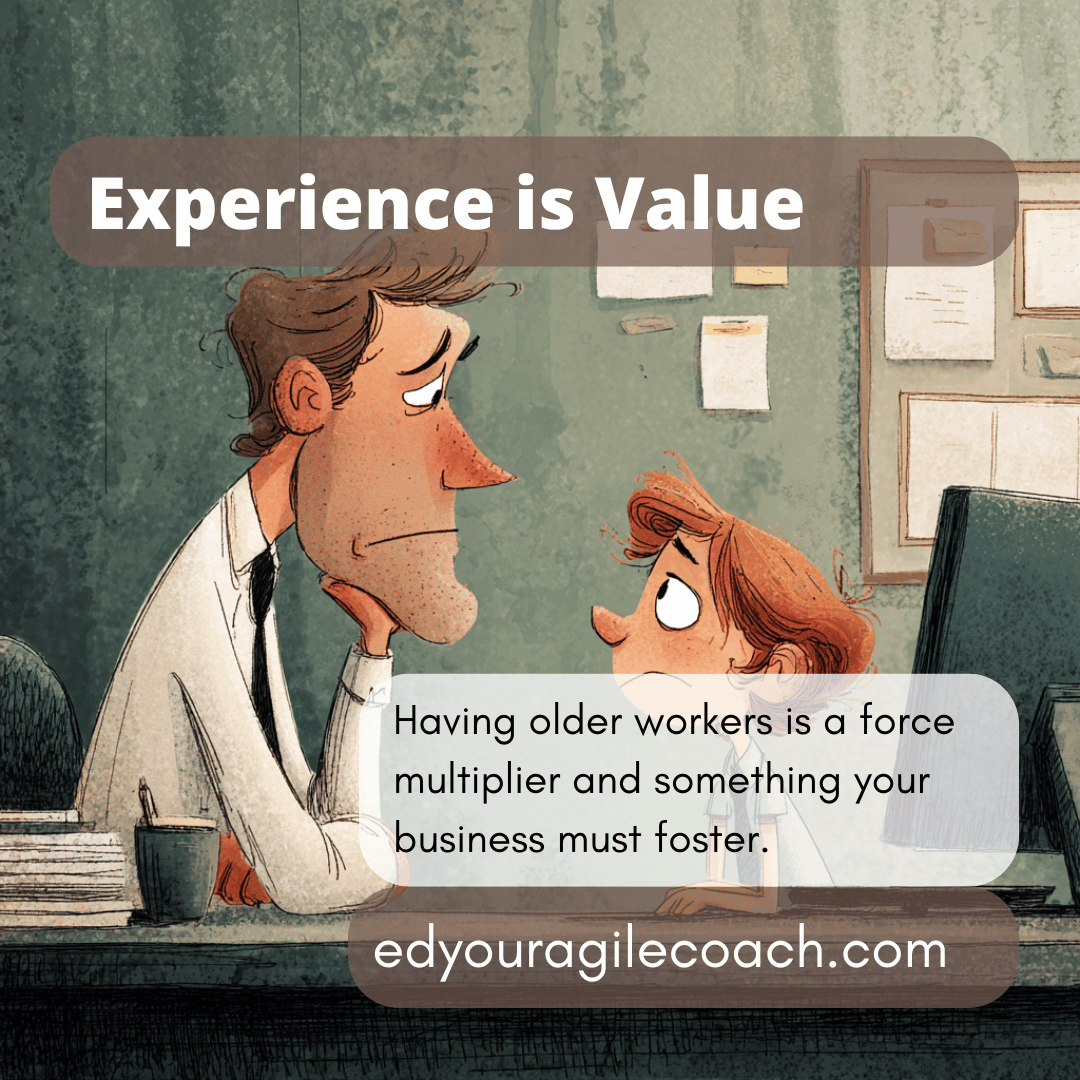
When those roles do open, people my age are often passed over because millennial workers appear to possess the technology and global vision that many corporate boards are seeking. It is not outright discrimination, but it is a bias, and I see it happening all the time in the technology world. I interviewed for a director of PMO role at a company, and the Human Resources professional who did the initial screen was the age of my grown stepdaughter. Over the video call, she struggled to hide her contempt for me, and for the first time in my career, I was treated like I was too old for a job. The experience stung.
Many corporate cultures consider people to have a 'shelf-life.' After a certain number of years in a role, they are either promoted or managed out of the company. It is why so many organizations suffer from the Peter Principle. People who stay are often promoted into roles where they're ineffective, and they remain there until they are fired or quit.
For those of us who jumped from role to role out of economic necessity, it is a double bind because our experience is seen as an obstacle to adopting new technologies. Layoffs target older workers because they have higher compensation and understand how the corporate system works. Once you realize this, it is easy to see why older workers can get cranky even when they are complimented about being good for their age.
The algorithms of social media remind me of plenty of young and attractive people in politics and business. It seems that anyone with a ring light, a septum piercing, and colorful eye makeup will attract attention, while a Generation X worker like me with lots of wisdom to share gets pushed to the sidelines. I am conscious of my graying beard and the possibility that some younger people might consider me old-fashioned.
I have not gotten to the point of yelling at my neighbor's children and telling them to get off my lawn, but I am concerned I might reach that milestone. It is why I blog and why I bother to get on social media. I want people to see that my shelf life has not expired. I have plenty of hard-earned guidance that will help you avoid some of the mishaps I experienced in my career.
The world needs experienced professionals to help prevent errors. People who can combine experience and a ring light, explaining not only what is happening but why, because we have a historical perspective that others might lack. I believe that aging is a privilege, and I want others to benefit from it rather than being placed on a metaphorical shelf. Anyway, I do look damn good for my age.
Until next time.



Comments ()