
The Coda of Triple-C.
January weighs heavily on many of us. Once the holiday festivities fade, the cold reality of a new business year takes hold. We face fresh budgets, tackle the "post-holiday" task list, and brave the slushy commute as corporate life resumes its pace. For a job seeker, this month can feel desperate; you fight to grab a hiring manager's attention, often feeling like you're shouting into a void. To combat this January gloom, I immersed myself in Bill Pasmore's Leading Continuous Change. Translating his concepts into infographics has provided more than just a helpful distraction—it has given me a new perspective. Today, I am wrapping up my series on Pasmore's work.
There is a saying in literary circles that bad artists copy while great artists steal. Akira Kurosawa's movie Seven Samurai inspired the 1960 Western The Magnificent Seven, directed by John Sturges. The first story unfolds in feudal Japan, and the second transports viewers to the American West following the Civil War. The plots are the same: mercenaries hired to fight bandits, but each is considered a masterpiece. The stories may be similar, but the characters are interesting and fresh across the films. Kurosawa openly critiques duty and tradition in his film, whereas Sturges illustrates the toll that a life of violence exacts on its perpetrators. I consider each movie a necessary part of a double feature. What is true of film counts in business writing. Pasmore is a great writer and a leader. He is also guilty of theft.
Deming and Pasmore -
The first thing you notice when you read Pasmore is that he is cribbing heavily from W. Edward Deming and his PDSA cycle for product improvement. PDSA is an acronym for plan-do-study-act. Deming was a pioneer in a new kind of leadership study. World War Two business leaders ignored Deming's ideas, so he trained industrialists in the ruined nations of Europe and Asia. Teaching relentless improvement, metrics for tracking and improving products, and a fundamental shift in leadership approach, Deming is one of the reasons the global economy is so competitive.
Pasmore's four-step process aligns with Deming's, but the steps do not line up. Deming says that planning should be the first step of change leadership. Pasmore argues that identifying what change must occur should come first. In my opinion, Deming's planning phase and Pasmore's deciding phase share a common goal: setting priorities and crafting plans. Once the team has solidified these elements, it proceeds with the project.
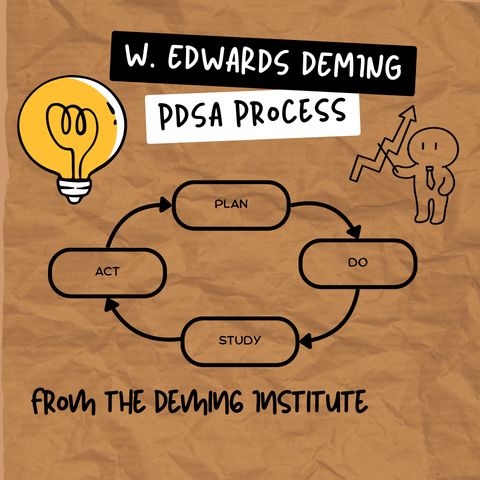
The doing phase of both Pasmore and Deming is effectively the same. Once the team reaches a decision, the organization must execute the change with ruthless efficiency. Half measures are unacceptable. The study phase resembles Pasmore's discerning phase, with a focus on learning valuable lessons from execution. Anyone with Agile experience will recognize that, whether we call this portion of change management discerning or checking, a retrospective will help us perform the necessary steps of continuous improvement.
Deming labels the final phase "acting," and I find that this does not align with Pasmore. Here, we act on the information gathered during the check phase and make the necessary adjustments. It is akin to the doing phase of the process, informed by the additional knowledge gathered in the checking phase. Both Deming and Pasmore consider their processes cyclical rather than linear, and we begin the process over again. If done correctly, it should create a virtuous cycle of improvement.
The Values of Change -
Where I think Pasmore excels is not in the process itself but in the discussion of the values necessary for the process to work. During the discovery phase, Pasmore argues that we must think "fewer" to be successful. In other words, to succeed in change, we need to identify the essential elements that must change and focus on them. It reminds me of the phrase from Peter Drucker: "First things first, and last things never."
In the deciding phase, Pasmore implores us to think in terms of scarcity. There is only so much time, energy, and money we can invest in an activity. Business leaders must be conscious of those limitations. The doing or execution phase is the most interesting to me. Pasmore says he wants people to think faster, but not in the traditional sense. Instead of forcing people to move faster, Pasmore insists on helping them focus and remove distractions so that a system enters a state known as flow. Creative people frequently discuss flow, the state in which they are most productive. Outside distractions fall away, and the task at hand becomes the focus. I suspect this is what Pasmore means when he says, "think faster." People in a flow state are better at enacting change.
The last mindset is being smarter. It does not mean you load up your team with PhDs or Jeopardy champions. Instead, it means examining the evidence without bias or agenda and making clear decisions. According to Pasmore's approach, these mindsets are as important as the actions taken.
I highly recommend Pasmore's book for scrum masters and coaches who want to explain organizational change to executives. Many people in those roles are accustomed to enforcing rules and are unable to facilitate necessary change. "Leading Continuous Change" provides a helpful framework for an ongoing change process and offers the professional encouragement we all need.
Complex, continuous change, or Triple-C, is the most significant challenge we can face in the business community. It is unforgiving and threatens the stability of our jobs and economy. Pasmore provided a helpful instructional guide to navigating it, which is why I am recommending it to each of you. Not a bad way to spend January.
Until next time.
 Follow

Comments ()